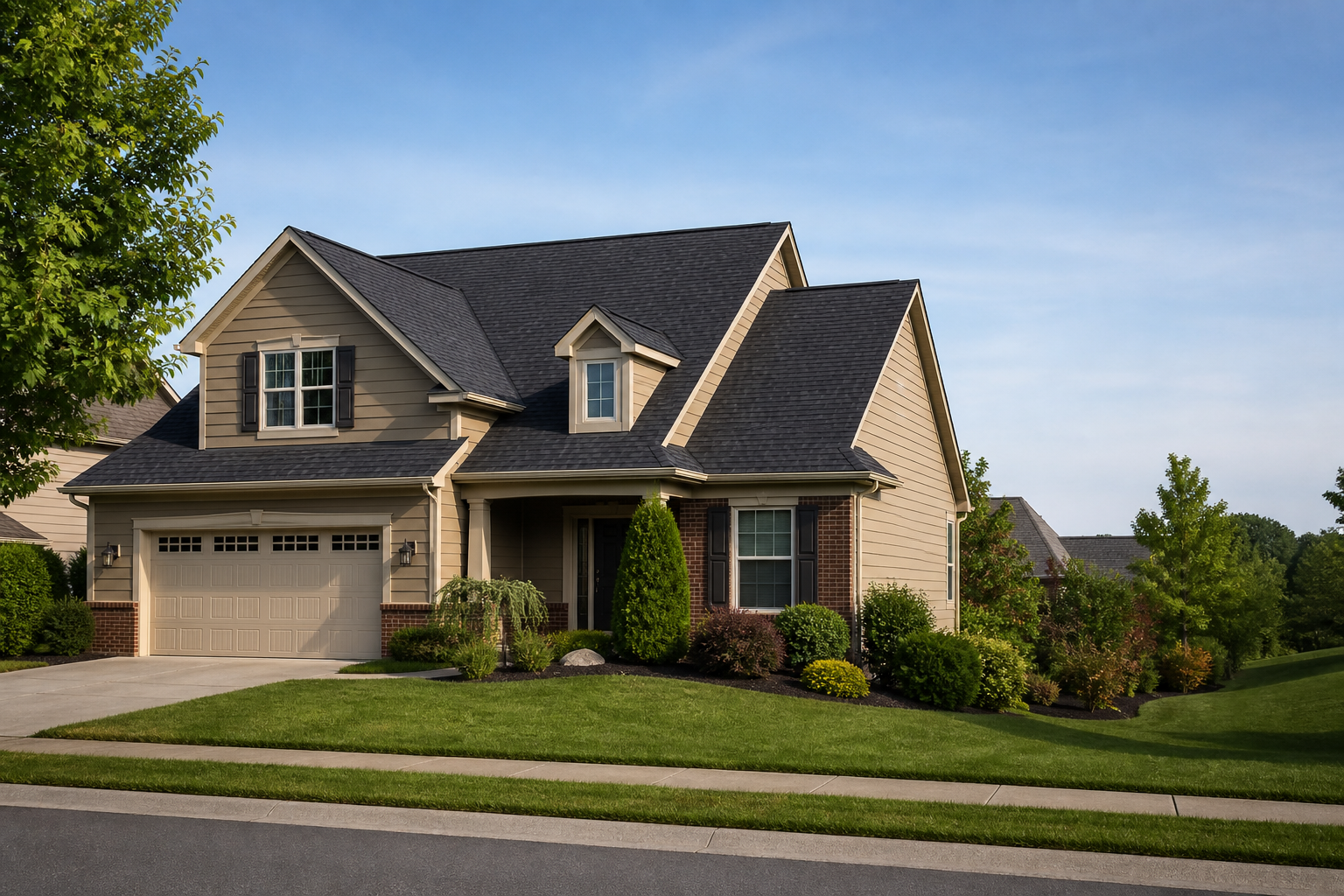
Starting from the ground before we ever get on the roof
We start on the ground, walking the perimeter of the house and looking at how water has been behaving around it. Staining on siding below a valley, a soft spot in the lawn near a downspout, or moss creeping across a shaded slope all tell us something before we ever touch a ladder. A homeowner who has lived in the house for years usually noticed some of this already, even without connecting it to the roof.
From there we look at the roofline itself from a distance, checking for sagging, checking the chimney flashing for gaps, and noting anything the eye can catch from the yard. This step takes only a few minutes, but it changes where we spend the most time once we are actually up there.
Flashing and valleys get more attention than the shingles
Once on the roof, the shingles themselves are rarely the first thing we look at closely. We check the flashing around every penetration first, the pipe boots, the chimney, any skylight, because that is where most leaks actually start. A shingle missing in the middle of a slope is usually cosmetic. A gap at a flashing seam almost never is.
Valleys get the same close attention, since water moves fastest through a valley in a heavy rain. Granule loss, cracking, or a valley that was closed instead of open tells us more about a roof's real condition than a count of missing shingles ever could.
What the attic tells us that the roof surface does not
When access allows, we go into the attic next, because a roof problem often shows up there before it shows up on the ceiling below. Water staining on the underside of the decking, rust on nail tips, or insulation that has gone flat and damp point to a leak that has been active longer than anyone realized. Ventilation gets checked here too, since a roof that cannot breathe properly ages faster than one that can, whatever the shingles look like on top.
Documenting the roof before quoting anything
Everything gets written down and photographed before we talk about scope. We would rather show a homeowner the actual flashing gap or the actual soft spot in the decking than describe it, because a photo settles the question of whether a repair is needed now or can wait another season.
That documentation becomes the basis for the estimate, which means the scope reflects what the roof actually needs rather than a standard package applied to every house on the block.
Why Dario walks every job himself
Dario walks these inspections in person for the same reason a photo is never quite enough: a roof looks different up close than it does from the curb. Two houses built the same year on the same street can have completely different roofs underneath, depending on how each one was maintained, and that only shows up once someone actually climbs up and looks.